Head of AGWI
Gordei Verbii
Reframing AI problems through deep mathematics
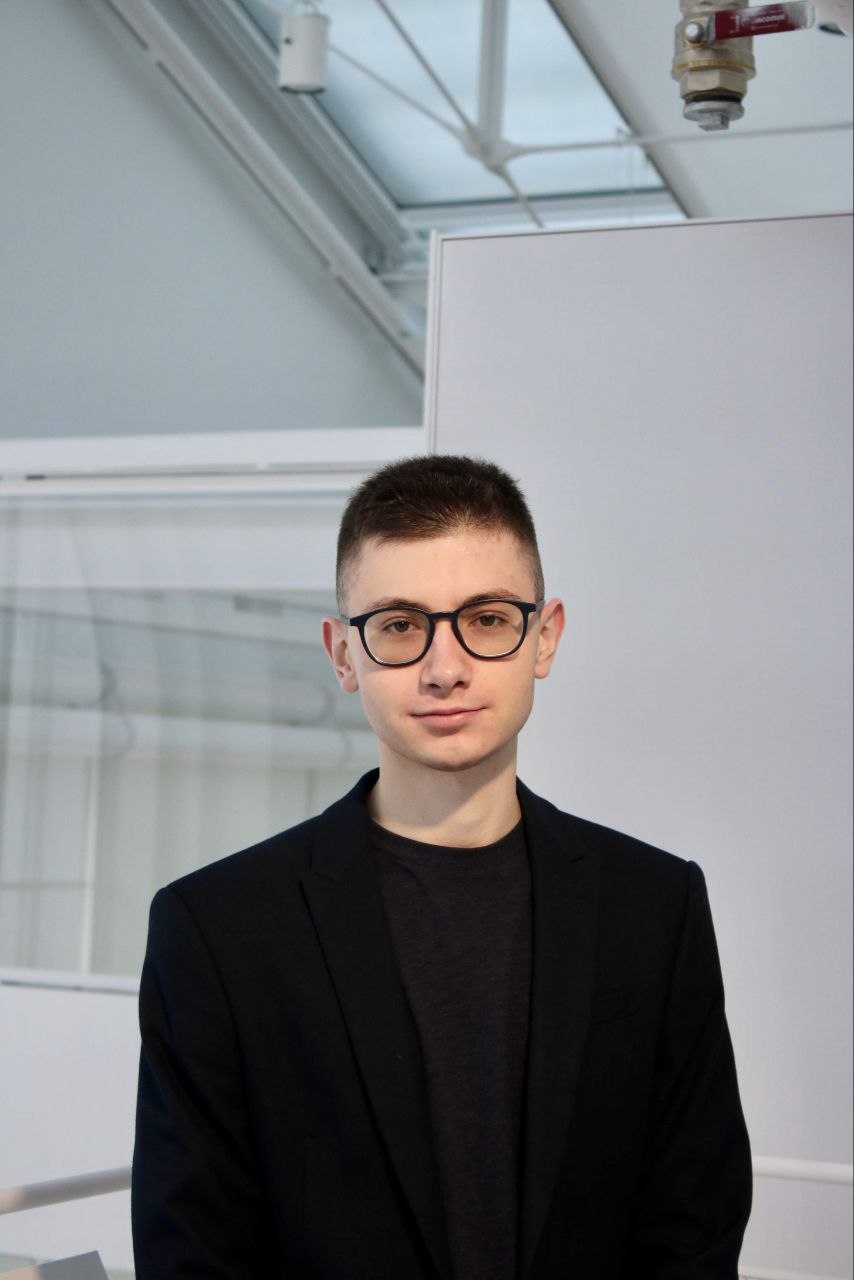
Gordei leads AGWI, reframing AI problems through deep mathematics. He is a PhD student at Shanghai Jiao Tong University, supervised by Yaoyu Zhang, researching the theory of deep learning. His work connects probability, geometry, optimal transport, and control.
Research interests
- Theory of deep learning
- Optimal transport
- Geometry
- Probability
- Control
Education
- PhD, Shanghai Jiao Tong University — in progress; theory of deep learning, supervised by Yaoyu Zhang.
- Specialist degree in Fundamental Mathematics, Lomonosov Moscow State University, 2020–2026. Concentration in probability theory; minor in optimal control.
Selected experience
- Head of AGWI, connecting mathematical foundations with AI research.
- Lead AI Researcher at Stratwise since September 2025, working across ranking, reinforcement learning, sequence models, and evaluation.
- Research in optimal transport at the Vega Institute Foundation, 2024–2025, and reinforcement learning on Cayley graphs through the ML in Algebra project.
- Research supervision and mentoring since April 2025; assistant scientific supervision at Lomonosov MSU since September 2024.
Selected & shared
work.
One Inverse Step is a Convex Program: Bayes-Limit Calibration of Diffusion Inversion
arXiv:2608.23094
Earlier version: Extracting Local Manifold Geometry from Pretrained Diffusion Models in One Inverse Step ↗ · ICML 2026 SPIGM Workshop; KDD 2026 GALOP Workshop
Domain-constrained Knowledge Accumulates Flashes of Insight through Contradictions at the Border of Domains
AI4Sci Korea 2026
CayleyPy RL: Pathfinding and Reinforcement Learning on Cayley Graphs
Advances in Theoretical and Mathematical Physics 30(1), 211–269
Spectral Fingerprinting of Deformable Bodies: Laplace–Beltrami Invariants for Soft Robot State Estimation
RoboSoft 2026
Persistent Homology for Topological Classification of Soft Robot Deformation Modes
RoboSoft 2026
Microlocal Observability: Wave Front Analysis for Vibration Control in Soft Structures
RoboSoft 2026
Information-Geometric Control: Natural Gradient Methods for Adaptive Soft Robot Learning
RoboSoft 2026
Physics-Informed Neural Operators for Closed-Loop Magnetic Swarm Control of Soft Robots
RoboSoft 2026
Multi-Fidelity Robotic Co-Design via the Refinement Limit
RSS 2026 Lab-to-Production Workshop: Toward Industrial-Grade Perception and Manipulation
Hidden Markov Models with Memory and Multi-Criteria Queue Optimization for Mining Fleet Management
Lomonosov Readings 2026 (Mechanics), Lomonosov MSU
The Stiefel–Procrustes Bridge: Differential Geometric Framework for Smooth Robot Locomotion–Manipulation Transitions
IROS 2025 PPNIV Workshop
Swarm Control via ODE-Driven Optimal Transport–Based Renormalization Group Flow
IROS 2025
Voronoi-Based Multi-Robot Autonomous Exploration in Unknown Environments via Randomized SOM-Based Q-Learning
IROS 2025
Optimal Stopping via Martingale Rainbow Deep Q-Learning: Risk-Sensitive Financial Decision-Making
ICAIF 2025 AI Meets Quantitative Finance Workshop
Self-Organizing Maps for Spatiotemporal Analysis of SSVI Vol. Surface Regimes
ICAIF 2025 AI Meets Quantitative Finance Workshop
Optimal Recovery Meets Bayesian Learning: Where Worst-Case Bounds Pay Off
Research projects
SSVI Surface Calibration via Schrödinger Bridge ↗
Gordei Verbii · Georgii Kilinkarov
Reinforcement Learning for Optimal Stopping with Financial Applications ↗
Gordei Verbii · Georgii Kilinkarov
Scale vs. Quantization: Mapping the Memory Wall on Consumer Hardware ↗
Nauan Darkhan · Gordei Verbii
Actuarial-Informed Neural Networks ↗
Gordei Verbii · Ilya Starikov